

How to Set Up an eSIM on Android (Google Pixel & Samsung)
Dec 16
4
min read
Choose the right eSIM when landing in one country and traveling to another.
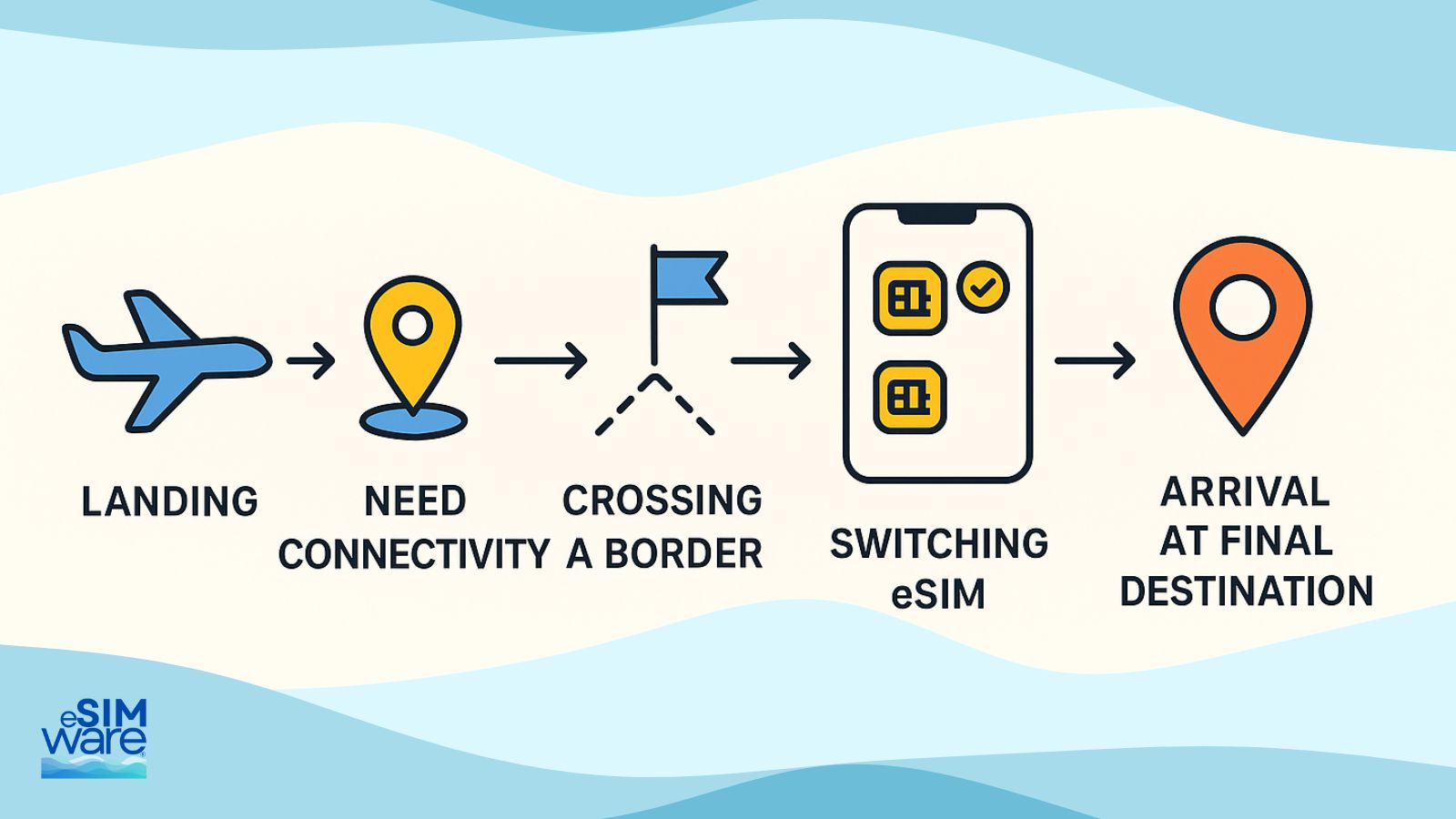
Modern travel routes are not always straightforward. Many travelers land in Country A, but their real destination is in Country B, often reached by taxi, bus, train, or shuttle.
This creates a common but tricky question:
Which eSIM should you buy:
the one for the country you land in,
or the one for the country you travel to?
Surprisingly, in many cases, the correct answer is:
👉 Both.
Even if the border is only a few kilometers away, mobile networks stop at country lines. If you cross into another country right after landing, your connection may disappear exactly when you need it most: to call your driver, use Uber, navigate with Google Maps, or receive confirmation codes.
Below are clear explanations and real-world examples.
When you step off a plane, you often need instant connectivity for:
Maps and GPS
Messaging apps (WhatsApp, Telegram, iMessage)
Rideshare or taxi coordination
Booking transport
Receiving security or banking codes
But if you continue your trip into a neighboring country, your eSIM may lose service at the border, sometimes within minutes of leaving the airport.

This is why many travelers choose:
A local eSIM for the country of arrival, to stay connected immediately.
A second eSIM for the final destination, where they will spend most of their time.
A very common situation:
You land at Geneva International Airport, located entirely in Switzerland, but your resort town, Megève, is in France, just 1.5 hours away.
As soon as your taxi crosses the French border:
❌ Your Swiss eSIM will stop working (unless you have expensive roaming).
✔ A French eSIM is required for the rest of your trip.
Recommended setup:
Swiss eSIM for arrival and airport logistics.
French eSIM for the drive and your stay in France.
Some airlines fly into Chisinau when direct flights to Ukraine are not available. Travelers then continue by bus to Odesa, Lviv, or Kyiv.
The Moldovan network does not work in Ukraine.
Recommended setup:
Moldova eSIM for arrival.
Ukraine eSIM for the bus journey and the whole stay.
The EuroAirport is unique:
It is physically in France
It has a dedicated Swiss exit
Germany is just a few minutes away
Your destination determines which country network you need.
Examples:
If staying in Mulhouse → France eSIM
If heading to Basel → Switzerland eSIM
If traveling to Freiburg → Germany eSIM
Some travelers need two eSIMs depending on border crossings.
Many Canadian airports are very close to the U.S. border.
If you land in Montreal and drive south:
A Canadian eSIM works only until you reach the border.
Once you enter the U.S., you need a U.S. eSIM.
This is one of the most common cross-border trips in Asia.
Hong Kong and mainland China operate two completely separate mobile networks.
A Hong Kong eSIM does not work in Shenzhen.
To stay connected through immigration checkpoints:
Use a Hong Kong eSIM upon landing.
Switch to a China eSIM before crossing the border.

✔ 1. Identify the country where you land
You need connectivity immediately after stepping off the plane.
✔ 2. Identify the country where you will stay
This is where you need stable, long-term service.
✔ 3. Consider buying two eSIMs
One for arrival, one for the destination.
✔ 4. Or choose a regional eSIM
If you’re traveling within a region (e.g., EU, Balkans, Asia-Pacific), a multi-country eSIM can cover all borders.
-1765898133371-675412900.jpeg)